How to Choose a Soft Wash Gun for a Pressure Washer
Choose a pressure washer soft wash gun by matching its flow, fittings, chemical compatibility and pressure range to your washer and cleaning solution. A short gun with suitable connections gives you better control, but it does not turn a high-pressure washer into a low-pressure soft wash system.
On this page (6 sections)
A pressure washer soft wash gun should give you controlled application, a suitable chemical path and a spray pattern that works at low impact. Check its maximum pressure and flow, then match the fittings to your washer, hose and foam cannon.
Soft washing is a system, not just a short handle. The pump, hose, gun, nozzle, chemical delivery method and distance from the surface all affect how much force reaches the material.
That system view matters because a part that works well in one setup can behave differently in another. A gun that feels steady with a foam cannon may feel sharp with a narrow nozzle.
A hose that passes enough water for rinsing may not suit every chemical accessory. Each part needs to work with the others before you judge the gun alone.
Pressure and flow are the first numbers to compare. The pump supplies the pressure, while the gun, hose and attached accessory must stay within their stated limits and pass the flow your washer provides.
Fittings are the next practical check. A secure match at the hose inlet and at the foam cannon or nozzle outlet prevents leaks and makes setup more predictable.
Chemical compatibility also needs a direct check. Seals, couplers and containers in the full path should suit the solution you plan to use, at the concentration and contact time the instructions describe.
Handling helps with accuracy, but it does not lower the force of the spray on its own. A short gun can help you stay at a steady distance, yet nozzle choice and distance still control how hard the water hits.
For a broader comparison of handle designs, see our guide to the best pressure washer gun. The right choice depends on the job and the rest of your equipment.
Think about where you will use it most often before you decide. Vehicle work often suits a compact handle and foam cannon, while siding, roofs and driveways may need a different spray pattern and a wider distance.
Start with the surface and the cleaning solution, then work backward to the gun. That order helps you avoid buying a handle that fits your hand but not your washer, hose or accessory.
A careful match at the start makes the rest of the wash easier to manage. You can focus on even coverage and safe rinsing instead of fighting leaks or awkward angles.
What should you check in a pressure washer soft wash gun?
The main checks are pressure control, flow, chemical compatibility, fittings and handling. A gun that fits your hose but cannot work with your intended solution or spray pattern may not be suitable.
How much pressure and flow does a soft wash gun need?
A soft wash gun should operate within the pressure and flow limits of your washer and accessories. Lower impact usually comes from a wider spray, greater distance, a suitable nozzle or a separate low-pressure chemical delivery method.
Do not assume that a gun marked for high pressure creates a gentle spray by itself. A short handle can improve control, but the pump still supplies the water pressure.
Flow matters because the gun, hose and foam cannon must pass enough water for the system to work properly. Too little flow can affect foam generation and rinsing, while excess flow can exceed an accessory's limit.
Check the pressure washer's rated gallons per minute and pounds per square inch before choosing. Compare those figures with the gun and any attached foam cannon or injector.
If you are unsure how pressure and flow combine during cleaning, read What Is Cleaning Power on a Pressure Washer? before you select an accessory.
Which fittings should a soft wash gun have?
The fittings must match the pressure washer hose and the accessory you plan to attach. Common connection points include the hose inlet, a quick-connect outlet and a foam cannon or wand connection.
Some guns use M22 hose fittings, while others connect through quick couplers. M22 sizes can differ, so check whether your hose uses a 14 mm or 15 mm inside diameter when the manufacturer specifies that distinction.
A pressure washer gun may look universal but still need an adapter. Our guide answers are pressure washer guns universal and explains why connection checks matter before ordering.
Look for a secure connection with no looseness or visible damage. Stop using the system if a fitting leaks under pressure, and depressurize it before attempting to tighten or replace a connection.
Are chemicals safe for every soft wash gun?
No. Chemical compatibility depends on the materials in the gun and the complete delivery path.
That includes seals, couplers, hose sections, injectors, foam cannons and any container that holds the solution.
Read the accessory instructions before using bleach, detergents or other cleaners. Do not mix chemicals unless the product instructions specifically allow it.
A foam cannon can spread detergent across a surface, but it does not automatically make every chemical safe for every component. If you need help choosing a detergent, see What Soap Can I Use in a Pressure Washer?.
Use the lowest useful concentration and prevent spray from reaching people, pets, plants, electrical equipment and incompatible materials. Follow the chemical label for protective equipment, storage and disposal.
Which pressure washer soft wash gun features help with control?
A short handle, a comfortable trigger and a swivel can make application easier, especially around vehicles and tight spaces. These features improve handling, but they do not replace a suitable nozzle or a safe pressure setting.
A shorter gun reduces the distance between your hands and the spray connection. That helps you guide the spray around wheel wells, siding details and other narrow areas.
It also makes changing angle easier without moving your whole arm. Small shifts in distance and direction often matter more than reaching with a long wand near paint or trim.
A swivel can reduce hose twisting while you move. It does not remove the need to inspect the hose and connections for wear.
That freedom matters most when you walk around a vehicle or along a wall. The hose follows your path more naturally, which keeps the spray steadier and reduces the pull at the gun.
The trigger should operate smoothly without forcing a tight grip. Keep both hands available when the setup feels difficult to control, and never point the gun at a person or animal.
A light, predictable trigger helps with short bursts and fine adjustments. It is easier to ease off near edges and seals when you do not need a tight grip to keep the gun working.
Grip shape and balance matter during longer sessions. A handle that feels fine for a quick rinse may tire your hand over a full wash, so consider how long you usually work without a break.
Weight distribution also affects control at close range. When the foam cannon or nozzle sits near your hands, small movements show up quickly in the spray pattern.
Care between jobs keeps those features working well. Rinse grit from the trigger area, check couplers for wear, and store the gun where fittings are not bent or crushed.
Trade offs are worth weighing before you choose. A very short gun gives close control but less reach, while a swivel adds convenience yet still needs a compatible hose and coupler.
You get the best result when handling, nozzle choice and pressure setting work together. A comfortable gun should support a gentle, even pass, not encourage you to move closer or tighten the spray.
Practice the setup on a tolerant surface first if you are unsure. That test run shows how the trigger, swivel and spray pattern feel before you use them on sensitive material.
Which pressure washer soft wash gun suits each use?
Choose the gun based on the accessory connection and the work pattern. A vehicle detailer may value a compact handle, while a larger property-cleaning setup may need higher flow and a longer hose arrangement.
Chemical Guys: compact vehicle and foam-cannon work
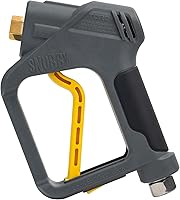
Chemical Guys makes the Snubby Short Pressure Washer Gun with Foam Cannon Attachment for vehicle washing and foam application. Its short-handle design is intended to improve control around cars, tight spaces, wheel wells and undercarriages.
The gun is rated for a maximum pressure of 3000 psi and a maximum flow rate of 10.5 gpm. It connects to standard fittings and works with Chemical Guys foam cannon pressure washer attachments.
The title and product details identify it as a Snubby gun with a foam cannon attachment. The model is EQP402, and the body is described as grey and yellow.
Choose this option if your main goal is controlled car washing with a foam cannon. Its stated flow rating is high, so confirm that your washer and attached accessory are also suitable before use.
McKillans: swivel control for detailing
McKillans makes the Short Pressure Washer Gun with Swivel, with a 3/8 in male plug and 1/4 in quick connector coupler. The swivel inlet lets the hose rotate during use, which can help reduce twisting as you move around a vehicle.
This gun has a maximum pressure of 3000 psi and a maximum flow rate of 2.6 gpm. It includes a short body, a lightweight pull trigger and preinstalled fittings with Teflon tape and Loctite.
The product uses stainless and brass fittings, according to the product description. Its model number is MK-PWG-001, and the listed power source is corded electric.
Choose it when your washer and foam cannon fit the stated connection setup and your work benefits from a swiveling hose inlet. Its lower stated flow rate than the other options makes a washer and accessory compatibility check especially important.
Tool Daily: a broader kit with foam cannon and tips
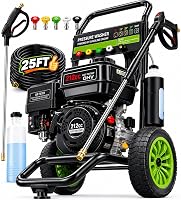
Tool Daily makes the Short Pressure Washer Gun with Foam Cannon, 1/4 in Quick Connect. The kit includes a pressure washer short gun, foam cannon, 5 nozzle tips and an M22-14 female to M22-15 male adapter.
The foam cannon has a 1-liter container and a 1/4 in quick-disconnect fitting. Its adjustable knob controls the mixture, while the nozzle helps set the spray pattern.
The kit's 5 tips have 0, 15, 25, 40 and 65 degree patterns. The gun is rated for a maximum pressure of 3000 psi and a maximum flow rate of 8 gpm.
Tool Daily states that the gun must connect to a pressure washer hose and is not for a garden hose, water hose or faucet directly. The M22-14 fitting is identified for Generac, Simpson, Briggs Stratton, Craftsman, Karcher and Ryobi pressure washers, while the M22-15 fitting is identified for Sun Joe, Campbell, MI-T-M, AR Blue, Stanley, Cleanforce, Simoniz and Excell power washers.
Choose this kit if you want several connection and spray options together. Check your exact hose fitting before setup, because the kit's compatibility depends on the M22 connection and it is not a direct faucet attachment.
How do you set up a soft wash gun safely?
Start by connecting the gun to a compatible pressure washer hose, then attach the foam cannon, injector or nozzle that matches the job. Keep the pressure washer off while making connections, and release trapped pressure before disconnecting anything.
Check that each fitting seats fully and feels secure before you start the pump. A loose coupler can shift under pressure, so stop and reseat it rather than trying to tighten it while the system is live.
Use clean water to check for leaks before adding detergent. A leak at the hose, coupler or gun can become more serious when the pump is running.
Run the water test away from the surface you plan to clean. Watch the inlet, outlet and any quick connect points, and note whether the spray pattern stays even across the full width.
If you use a foam cannon, fill its container according to the chemical and accessory instructions. Adjust the mixture gradually rather than starting with the strongest concentration.
Warm water, correct dilution and a clean container all affect the foam you get. Rinse the bottle after use when the instructions call for it, so leftover solution does not sit in the gun or cannon.
Point the gun toward a safe area before starting the pump. Use a wide spray and begin at a greater distance from the surface, then move closer only if the material and cleaning instructions allow it.
Keep the spray moving in steady passes instead of holding it in one spot. That habit helps spread the solution evenly and reduces the chance of forcing water into seams, seals or mortar joints.
Rinse chemical residue from the surface and surrounding areas. Plants, painted trim, glass, metals, seals and nearby property may need special care.
Shield nearby plants and rinse them with clean water if spray drifts toward them. Cover or move items that do not need to get wet, and keep people and pets clear of the work area.
After the job, turn the pump off and release pressure before you disconnect anything. Flush the gun, hose and accessory with clean water when the product instructions require it, then let the parts dry before storage.
Inspect the hose, seals and fittings while everything is clean and dry. Replace a worn part before the next use, since a small leak during setup can turn into a bigger problem under pressure.
Store the gun protected from freezing and physical damage. Good care keeps the trigger, couplers and swivel working smoothly for the next wash.
What should you avoid when soft washing?
Avoid using a narrow, concentrated spray on delicate surfaces. High force can damage paint, mortar, seals, wood, siding and roofing materials even when the cleaning solution is appropriate.
Do not exceed the lowest-rated pressure or flow limit in the system. The gun, hose, foam cannon, nozzle and pressure washer all need to work within their stated limits.
Never connect a pressure washer gun directly to a garden hose unless the product specifically supports that setup. The Tool Daily gun, for example, is identified as requiring a pressure washer hose.
Do not leave cleaning solution in the gun, foam cannon or hose longer than the accessory instructions allow. Rinse the system with clean water when required, then store the parts dry and protected from freezing.
For larger jobs, compare equipment intended for a best commercial pressure washer gun setup or a best industrial pressure washer gun setup. Those use cases can place different demands on flow, fittings and duty cycle.
How do you choose between these soft wash guns?
Pick Chemical Guys for compact vehicle washing and foam-cannon work with a short handle and a stated 10.5 gpm maximum flow rate. Pick McKillans when its swivel inlet, 3/8 in male plug and 1/4 in quick connector match your setup.
Pick Tool Daily when you want a wider kit with a 1-liter foam cannon, 5 spray tips and an M22 adapter. It requires a pressure washer hose and is not a direct garden-hose or faucet connection.
Your pressure washer's pump type also affects the system's output and suitability. Compare the best pressure washer pump type before choosing a gun for frequent work.
If you use a Karcher washer, check the fitting details carefully and compare best replacement guns for Karcher pressure washers before ordering.
The best pressure washer soft wash gun is the one that matches your hose, flow, pressure range and chemical path. Choose the setup that gives you a controlled spray for the surface, then start gently and adjust only within the safe limits of every connected part.
Frequently asked questions
What is a soft wash gun for a pressure washer?
A soft wash gun is a pressure washer handle or applicator used to spread water and cleaning solution at lower impact than a focused pressure-washer stream. The gun itself does not set every part of the system.
Pump output, nozzle choice, injector or foam cannon, hose, fittings and distance from the surface all affect the final spray.
Can I use any pressure washer gun for soft washing?
No. Check the gun's pressure and flow limits, inlet and outlet fittings, chemical compatibility and connection to your hose or foam cannon.
A gun may physically attach to a washer but still be a poor soft wash choice if the fittings leak, the flow does not suit the accessory or the spray is too forceful for the surface.
What pressure is best for soft washing?
Use the lowest pressure that applies the solution evenly and rinses the surface without damage. The right setting depends on the material, nozzle, distance, pump and detergent.
Start farther away with a wider spray, then adjust carefully while avoiding concentrated spray on siding, paint, seals, mortar and delicate surfaces.
Can a pressure washer gun handle bleach or cleaning chemicals?
Only use a chemical solution when the gun, hose, injector and other wet parts are compatible with it. Chemical resistance varies by material and concentration.
Follow the accessory and chemical instructions, wear the required protective equipment, prevent runoff, and rinse the system with clean water after use when the instructions call for it.