9 Best Pressure Washers for Concrete (November 2026)
The best pressure washers for concrete include the MEKOH 20” Heavy-Duty Pressure Washer Surface Cleaner for fast, even concrete passes, the Westinghouse WPX3400 Gas Pressure Washer for heavy concrete grime, and the LWQ Pressure Washer for compact concrete cleaning.
On this page (8 sections)
- How we ranked the best pressure washers for concrete
- Concrete pressure washer picks, from heavy duty to compact
- What PSI is best for concrete?
- How much GPM do you need for a concrete pressure washer?
- Should you use a surface cleaner on concrete?
- How should you pressure wash a concrete slab?
- Which electric pressure washer is best for concrete?
- Verdict: which pressure washer for concrete should you choose?
The best pressure washer for concrete depends on both pressure and flow. Choose the Westinghouse WPX3400 for heavy grime, the Greenworks 3000 PSI for strong electric output, or add the MEKOH 20 in surface cleaner when you want faster, more even passes across a slab.
Concrete can handle more spray pressure than many painted or delicate surfaces, but more power is not automatically better. Your results depend on the machine's PSI, water flow, nozzle, distance from the surface and the pace of each pass.
For related outdoor jobs, compare our guide to the best pressure washer for patios, the best pressure washer for driveways and the best pressure washer for pavers.
Our picks at a glance
-
1
 Best for fast, even concrete passes
MEKOH 20” Heavy-Duty Pressure Washer Surface Cleaner
9.7/10 our score
See it on Amazon -
2
 Best for heavy concrete grime
Westinghouse WPX3400 Gas Pressure Washer
9.6/10 our score
See it on Amazon -
3
- 4
 Check it
MZK Lightweight Pressure Washer
Best for easy carrying - 5
 Check it
Westinghouse WPX3000e Electric Pressure Washer
Best for balanced electric power - 6
 Best for certified electric outputCheck it
- 7
 Check it
RYOBI 1800 PSI Electric Pressure Washer
Best for light concrete touch-ups - 8
 Best for medium-duty concreteCheck it
- 9
 Check it
TOR 14" Pressure Washer Surface Cleaner
Best for a stainless steel surface cleaner
How we ranked the best pressure washers for concrete
We ranked these picks by pressure, flow, spray control, power source, mobility and fit for concrete cleaning. Our score weighs specs, features and buyer feedback against what you are shopping for.
A surface cleaner is different from a complete pressure washer. The MEKOH and TOR attachments need a compatible machine, while the other products here are full pressure washers with their own spray equipment.
That distinction matters for setup and cost. A surface cleaner adds a wide path and steady height, while a full washer gives you a gun, wand and nozzles in one package.
The MEKOH ranks first because its 20 in path, dual rotating jets, handles and wheels directly address the slow, uneven passes that can happen with a wand. The Westinghouse WPX3400 follows because its 3400 PSI and 2.6 GPM combination is the strongest full-machine setup in this group.
We also weighed how each option suits daily use. Weight, storage size, hose length and cord reach can matter as much as the headline numbers on a large slab.
Concrete pressure washer picks, from heavy duty to compact
The best machine for a large stained driveway is not the same as the best choice for a small walkway. Match the pick to the size of the area, the grime you need to remove and how much setup you want to handle.
| Product | Best for | Working fit | Path size | Connection | Our score |
|---|---|---|---|---|---|
| MEKOH 20” Heavy-Duty Pressure Washer Surface Cleaner | fast, even concrete passes | Pressure washers at least 2000 PSI and 2 GPM | 20 in | 3/8 in quick-connect | 9.7 |
| Westinghouse WPX3400 Gas Pressure Washer | heavy concrete grime | 9.6 | |||
| LWQ Pressure Washer | compact concrete cleaning | 9.6 | |||
| MZK Lightweight Pressure Washer | easy carrying | 9.5 | |||
| Westinghouse WPX3000e Electric Pressure Washer | balanced electric power | 9.4 | |||
| Greenworks 3000 PSI | certified electric output | 9.1 | |||
| RYOBI 1800 PSI Electric Pressure Washer | light concrete touch-ups | 9.0 | |||
| Greenworks 2100 PSI | medium-duty concrete | 8.9 | |||
| TOR 14" Pressure Washer Surface Cleaner | a stainless steel surface cleaner | Most 2000–4000 PSI pressure washers | 1/4 in quick-connect | 8.3 |
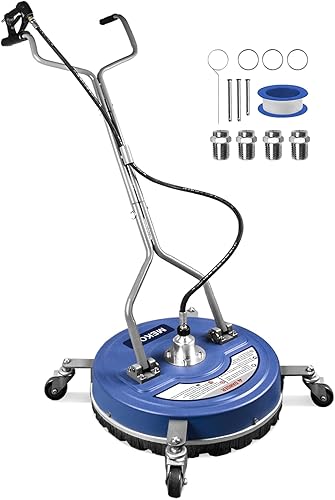
MEKOH 20” Heavy-Duty Pressure Washer Surface Cleaner: Best for fast, even concrete passes
- 20 in surface-cleaner path
- 4500 PSI maximum pressure
- 4 GPM maximum flow
- 2 handles and 4 wheels
The MEKOH turns a compatible pressure washer into a wheeled surface-cleaning setup. Its 20 in body and dual rotating jets suit large flat concrete areas.
Pros
- Wide 20 in cleaning path
- Dual handles and 4 casters
- Works with cold, hot or soap water
Cons
- Needs a separate pressure washer
- Better results call for 3400 PSI or higher
The MEKOH 20 in surface cleaner is the best choice when your main goal is covering broad, flat concrete efficiently. Its dual high-pressure rotating jets spread the cleaning action across a 20 in path instead of concentrating all the work in one wand tip.
It needs a separate pressure washer and works with machines at least 2000 PSI and 2 GPM. MEKOH says better results come from 3400 PSI or higher, so check both the pressure and flow of your machine before connecting it.
Four casters keep the nozzles at a fixed height as you push the attachment. The two angle-adjustable handles can make long passes easier, while the PP body, solid brass and sealed bearing are designed for cold, hot or soap water.
The attachment has a 3/8 in quick-connect and a 63 in hose. Its stated maximums are 4500 PSI and 4 GPM, but your pressure washer still controls the working output.
Choose it for driveways, sidewalks, garages, patios or other flat surfaces where a wide path saves time. It is less useful if you do not already have a compatible pressure washer.
Westinghouse WPX3400 Gas Pressure Washer: Best for heavy concrete grime
- 3400 PSI and 2.6 GPM
- 212cc 4-stroke gas engine
- 0.5 gallon onboard soap tank
- 5 quick-connect nozzles
The WPX3400 gives you the pressure and flow needed for demanding concrete work. Its gas engine and wheels suit larger outdoor jobs where cord placement is inconvenient.
Pros
- Highest full-machine pressure here
- 2.6 GPM flow
- Includes 5 nozzles and a spray gun
Cons
- Gas-powered setup
- Heavier at 28.6 kg
The Westinghouse WPX3400 is the strongest full pressure washer here for demanding concrete work. Its 3400 PSI and 2.6 GPM combination gives you both concentrated force and enough flow for rinsing loosened dirt.
A 212cc 4-stroke gas engine powers the unit, so it suits larger outdoor jobs where you do not want to manage an electric cord. The steel frame and 12 in never-flat wheels support movement across an outdoor work area.
The washer includes a 25 ft abrasion-resistant hose, spray gun, wand and 5 quick-connect nozzles. Its nozzles cover 0°, 15°, 25°, 40° and soap, giving you choices for concrete and nearby surfaces.
An onboard 0.5 gallon soap tank can help with detergent-based cleaning when the job calls for it. The machine also includes engine oil, tools and a quick-start guide.
Choose this model for large driveways, garage floors and stubborn grime. Its fuel-powered design and 28.6 kg weight make it a better fit for buyers who accept more setup in exchange for higher output.
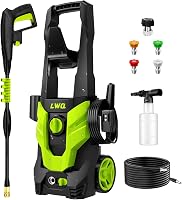
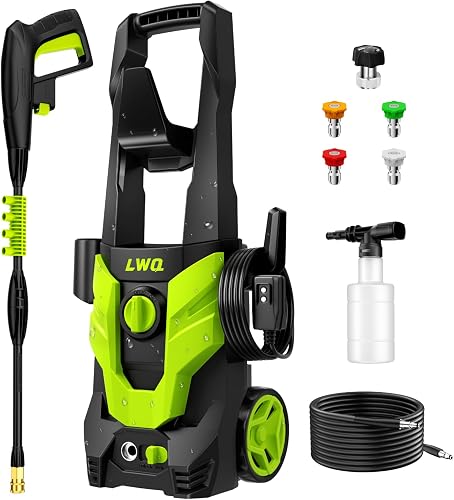
LWQ Pressure Washer: Best for compact concrete cleaning
- 2030 PSI maximum pressure
- 2.5 GPM maximum flow
- 4 metal quick-connect nozzles
- Foam cannon and 2 rollers
The LWQ combines a compact body with 2.5 GPM flow for home concrete, driveway and patio work. Its rollers and anti-tipping base make moving and storing it simpler.
Pros
- Compact dimensions
- 2.5 GPM water flow
- Foam cannon and 4 nozzles
Cons
- 2030 PSI limits heavy-duty surface-cleaner use
- Requires air to be exhausted from the hoses before use
The LWQ is a strong compact pick for concrete, pavement, patios and driveways. Its 2030 PSI maximum pressure and 2.5 GPM maximum flow give it a useful balance for regular home cleaning.
Four metal quick-connect nozzles cover 0°, 15°, 25° and 40°. A foam cannon and detergent bottle add another cleaning option, and the detergent bottle can hold chemicals such as bleach without sending them through the pump.
Two rollers make the 16.6 lb washer easier to move. The anti-tipping base helps it stay stable when parked, while the compact 18 x 14 x 11 in body is easier to store in a garage or pantry.
LWQ also supports faucet or bucket water collection. Before turning it on, exhaust air from the high-pressure hose and inlet hose so the machine can spray properly.
Choose it when you want more flow than many compact electric washers without moving a larger frame. Its 2030 PSI maximum makes it less suited to the most demanding concrete stains than the 3000 PSI and 3400 PSI picks.
MZK Lightweight Pressure Washer: Best for easy carrying
- 9.9 lb weight
- Up to 2.0 GPM flow
- 4-gear adjustable nozzle
- 21 ft hose and 17 ft power cord
The MZK is a practical choice when you need to carry the washer between concrete areas. Its adjustable nozzle covers concentrated and wide spray patterns.
Pros
- Lightweight 9.9 lb body
- Foam cannon included
- Compact storage design
Cons
- The data does not state a maximum PSI
- Less suited to large slabs than a higher-flow machine
The MZK is the easiest full washer here to carry between small concrete areas. It weighs 9.9 lb and includes a 21 ft hose plus a 17 ft power cord for movement around a yard.
Its adjustable nozzle offers 0°, 15°–25°, 25°–60° and 60°–120° spray ranges. That lets you move from a narrow stream to a wider fan as the surface and cleaning task change.
MZK states water flow up to 2.0 GPM and includes a foam cannon for detergent application. The compact body is designed for storage in a garage, pantry or car trunk.
The data does not state a maximum PSI, so this is not the pick for buyers who want to compare pressure numbers directly. It makes more sense for portable home cleaning than for large, deeply stained slabs.
Choose it for small patios, paths and concrete touch-ups where low carrying weight matters. Use a wider or more powerful setup for a large driveway.
Westinghouse WPX3000e Electric Pressure Washer: Best for balanced electric power
- 3000 max PSI and 1.76 max GPM
- 2600 rated PSI and 1.1 rated GPM
- Induction motor
- 5 nozzle set and 0.45 gallon soap tank
The WPX3000e gives concrete-focused electric cleaning with a rated 2600 PSI and a long GFCI cord. It fits buyers who want more power than a light-duty washer.
Pros
- 2600 rated PSI
- Induction motor
- 5 nozzles and onboard soap tank
Cons
- Rated flow is 1.1 GPM
- Heavier than the compact electric picks
The Westinghouse WPX3000e is the balanced electric choice for concrete. It delivers 3000 max PSI and 1.76 max GPM, with 2600 rated PSI and 1.1 rated GPM.
Its 120V induction motor and maintenance-free axial 3-piston auto-stop pump suit buyers who want electric operation. The auto-stop pump helps when you release the trigger and do not need constant bypass flow.
A 35 ft GFCI cord gives more reach from the outlet, while 10 in never-flat wheels help move the 36.8 lb frame. That reach is useful when the nearest outlet sits away from the driveway or patio.
The washer includes a 25 ft hose, metal spray gun and wand, plus 0°, 15°, 25°, soap and turbo nozzles. The wider tips suit general rinsing, while the turbo tip concentrates spray for stubborn spots.
Its 0.45 gallon onboard soap tank supports detergent application when you need more than water alone. Use a suitable detergent and rinse well so residue does not stay on the surface.
Choose this model for a mix of concrete, siding, fences and vehicles. Its rated flow is lower than the gas WPX3400 and the Greenworks 3000 PSI, so pace may differ on large areas.
It suits homeowners who plan regular outdoor cleaning rather than occasional light touch-ups. Electric power keeps fuel and oil out of the routine, though you still need to manage the cord.
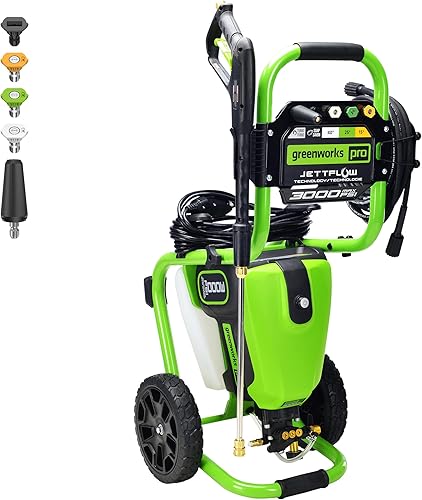
Greenworks 3000 PSI: Best for certified electric output
- 3000 PSI and 2.0 GPM
- 14 Amp TruBrushless motor
- 25 ft Uberflex hose
- 15°, 25°, 40°, soap and turbo nozzles
The Greenworks 3000 PSI pairs 2.0 GPM flow with an electric brushless motor. Its nozzle set gives you several ways to adjust the spray for concrete and nearby surfaces.
Pros
- 3000 PSI and 2.0 GPM
- PWMA certified
- Turbo and soap nozzles included
Cons
- Maximum inlet water temperature is 104°F
- Heavy at 23.5 kg
The Greenworks 3000 PSI is a strong electric option when you want 2.0 GPM along with 3000 PSI. Its 14 Amp TruBrushless motor and cast aluminum axial cam pump are built for high-output cleaning.
The brushless design suits buyers who want steady electric performance for frequent use. Follow the start steps in the manual during setup.
Greenworks includes a 25 ft Uberflex kink-resistant hose, metal gun and 15°, 25° and 40° tips. The kink-resistant hose helps keep flow steady around corners or past obstacles.
Soap and turbo nozzles add control for detergent work and stubborn dirt. Use the soap tip for cleaner and the turbo tip sparingly on tough grime.
The unit is PWMA certified, and its maximum inlet water temperature is 104°F (40°C). Keep that limit in mind when choosing your water source on a hot day.
At 23.5 kg, it is heavier than the compact electric choices. Choose it for patios, driveways and slabs where electric power and 2.0 GPM flow matter.
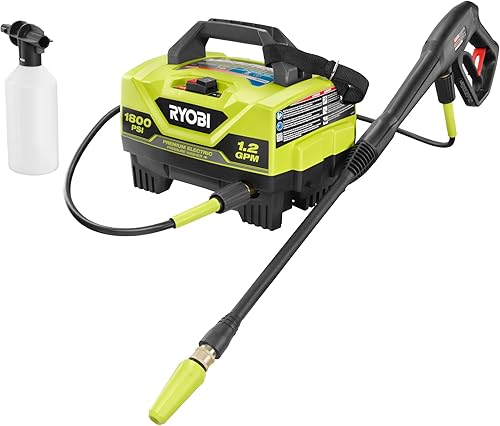
RYOBI 1800 PSI Electric Pressure Washer: Best for light concrete touch-ups
- 1800 PSI and 1.2 GPM
- 20 ft hose
- 15°, soap and turbo nozzles
- Compact 12.5 x 10 x 9 in body
The RYOBI suits smaller concrete jobs and routine touch-ups where compact storage matters. Its 1800 PSI output is more limited than the higher-pressure choices.
Pros
- Small storage footprint
- Turbo nozzle included
- 20 ft hose
Cons
- Lowest pressure among the full washers here
- 1.2 GPM flow
The RYOBI 1800 PSI is best for light concrete touch-ups and smaller outdoor cleaning tasks. Its 1800 PSI and 1.2 GPM output are more limited than the other full washers in this roundup.
That lower output suits routine dirt rather than deep stains. It can refresh a walkway or patio area without the force that might be harder to control on weak concrete.
The compact 12.5 x 10 x 9 in body is easy to store in a small space. A 20 ft hose gives enough reach for nearby work, and the corded electric design keeps the setup simple.
RYOBI includes a trigger handle with M22 connections, spray wand, 15° nozzle, soap nozzle and turbo nozzle. The M22 connections should be checked against any accessory you plan to add later.
The turbo nozzle is intended to provide more cleaning power than a standard spray pattern. Keep it moving and avoid holding it in one place on concrete.
Choose it for small walkways, light dirt and occasional cleaning. It is not the best match for heavy stains across a large driveway, where more pressure, flow or a surface cleaner can save time.
The trade-off is clear for the price of portability. You give up cleaning speed on big slabs in exchange for a washer that is simpler to carry, set up and tuck away.
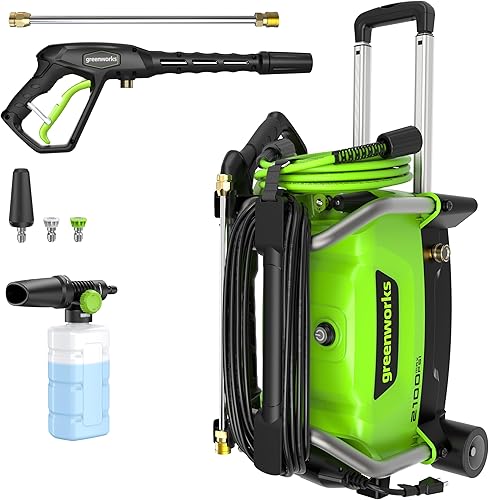
Greenworks 2100 PSI: Best for medium-duty concrete
- 2100 PSI and 1.2 GPM
- 35 ft power cord with GFCI
- 25° and 40° nozzles
- Telescoping handle
This Greenworks model fits medium-duty concrete cleaning around the home. The telescoping handle, long cord and included turbo nozzle make routine setup straightforward.
Pros
- GFCI safety device
- Long 35 ft power cord
- No gas, oil or spark plugs
Cons
- 1.2 GPM flow
- Less output than the 3000 PSI Greenworks
The Greenworks 2100 PSI fits medium-duty concrete cleaning around the home. Its 2100 PSI and 1.2 GPM combination is intended for concrete patios, sidewalks and small driveways.
The output sits above light touch-up models without reaching the higher pressure of a 3000 PSI washer. It suits regular dirt and surface film more than deeply set stains.
A 25 ft hose and 35 ft power cord give you useful reach. The longer cord helps when the outlet is not close to the area you plan to clean.
The GFCI plug includes an integrated safety device, and the push-button start avoids gas, oil, spark plugs, air filters and a pull cord. That simple start is a plus for quick jobs.
The washer includes a gun, 25° general-purpose nozzle, 40° gentle-cleaning nozzle, turbo nozzle, soap applicator and 1/4 in universal quick-connect system. The quick-connect makes nozzle changes faster during a job.
Its telescoping handle collapses for storage. Pull it out for moving the unit and push it down when space in the garage is tight.
Choose it when you want low-maintenance electric cleaning with more output than a light-duty washer. The 1.2 GPM flow is modest, so large concrete areas may take longer.
It works best when you clean often enough to value easy setup. For a very large driveway, a higher-flow model or a surface cleaner will usually cover ground faster.
TOR 14" Pressure Washer Surface Cleaner: Best for a stainless steel surface cleaner
- 14 in cleaning path
- 4000 PSI maximum pressure
- Stainless steel construction
- 4 caster wheels and mesh inlet filter
The TOR is a narrower surface-cleaner attachment for compatible 2000–4000 PSI machines. Stainless steel construction and four wheels make it useful when you want an even path on concrete.
Pros
- Stainless steel body
- 14 in cleaning path
- Mesh filter and replacement parts
Cons
- Needs a separate pressure washer
- 3/8 in outlets need an adapter that is not included
The TOR 14 in surface cleaner is the best attachment here when you want a stainless steel body and a narrower cleaning path. It fits most 2000–4000 PSI pressure washers through a 1/4 in quick-connect plug.
Its dual rotating nozzles create a consistent cleaning path across driveways, patios, sidewalks and decks. Four caster wheels hold the nozzle height steady as you move, and the splash-free skirt helps limit spray around the operator.
A mesh inlet filter helps keep impurities from reaching the nozzles. The bundle includes 2 extension wands, 2 replacement nozzles, 4 O-rings, a nozzle-cleaner needle and Teflon tape.
Check the connection before ordering. Machines with 3/8 in outlets need an adapter, and that adapter is not included.
Garden hoses cannot power this attachment.
Choose TOR when 14 in coverage suits your space and you prefer stainless steel. Pick MEKOH instead when the wider 20 in path and dual-handle design matter more.
What PSI is best for concrete?
A pressure washer for concrete should usually start around 2000 PSI, with higher output helping on stubborn grime and larger areas. The right setting still depends on the surface condition, nozzle angle, distance and whether you use a surface cleaner.
The 1800 PSI RYOBI is better suited to light touch-ups. The Greenworks 2100 PSI and LWQ 2030 PSI fit regular home work, while the 3000 PSI, 3400 PSI and compatible surface-cleaner options give you more room for difficult jobs.
Read our guides to What PSI Is a Heavy Duty Pressure Washer? and What PSI Is a Light Duty Pressure Washer? before choosing a nozzle or machine.
How much GPM do you need for a concrete pressure washer?
GPM controls how much water moves across the surface, so higher flow can help rinse loosened dirt faster. Compare GPM with PSI instead of judging the machine by pressure alone.
PSI describes how hard the water hits, while GPM describes how much water keeps arriving. Concrete cleaning needs both, since pressure breaks dirt loose and flow carries it away.
A washer with high PSI but low flow may blast a narrow spot yet rinse slowly. A washer with stronger flow can cover more area each pass and leave less dirty water behind.
The Westinghouse WPX3400 reaches 2.6 GPM, the LWQ reaches 2.5 GPM and the Greenworks 3000 PSI reaches 2.0 GPM. Those figures help compare rinsing speed on a driveway or patio.
The RYOBI and Greenworks 2100 PSI both use 1.2 GPM, which can work for smaller areas but may take longer on a large slab. The Westinghouse WPX3000e lists 1.76 max GPM and 1.1 rated GPM, so check which figure matters for your use.
Flow also affects a surface cleaner and its rotating jets. A 20 in path needs enough water to keep both jets spinning across the full width.
A surface cleaner has a flow requirement too. MEKOH calls for at least 2 GPM, so pair it with a machine that meets that minimum.
If the spinning bar slows or stops, low flow may be part of the cause. MEKOH also points to insufficient pressure or clogged nozzles, so check all three before continuing.
Choose flow for the size of your job, not just the pressure number. Small paths can manage with less flow, while a full driveway benefits from higher rates.
Should you use a surface cleaner on concrete?
Use a surface cleaner when you want faster, more even coverage across a broad flat area. The wheeled housing keeps the rotating jets at a steady height, which can reduce uneven striping from wand passes.
A wand spray changes with arm height, angle and speed. A surface cleaner holds its nozzles at a set distance, so each pass cleans more evenly at a steady pace.
MEKOH offers a 20 in path and fits washers at least 2000 PSI and 2 GPM. MEKOH says 3400 PSI or higher gives better results, so check your machine before connecting it.
TOR offers a 14 in path and fits most 2000–4000 PSI machines, but a 3/8 in outlet needs an adapter. TOR uses a 1/4 in quick-connect plug, so check fitment before ordering.
The wider MEKOH path covers more ground on a driveway or garage floor. The narrower TOR path may suit tighter patios, decks and walkways where a large housing is harder to turn.
Both designs use dual rotating nozzles to clean across the path. That spinning action spreads force instead of leaving a single wand line across the concrete.
Four caster wheels help the attachment glide without lifting. The wheels also protect the nozzles by keeping them at a fixed height above the surface.
Keep the attachment moving at a steady pace. Moving too fast can leave dirt behind, while stopping in one spot can overclean that spot.
If the spinning bar slows or stops, check pressure and flow, then inspect the nozzles for clogs. Surface cleaners also need a separate pressure washer and cannot run from a garden hose alone.
How should you pressure wash a concrete slab?
Clear loose debris, connect the water supply, choose a suitable spray pattern and work in steady overlapping passes. Start with a less aggressive approach, then adjust the nozzle, distance and pace only as needed.
Use the 25° or 40° pattern for broader coverage when the surface allows it. A narrow 0° stream concentrates force in one spot, so avoid holding it close to concrete for too long.
Keep electrical connections away from standing water and follow the pressure washer's operating instructions. With a surface cleaner, keep the housing level and move slowly enough for the rotating jets to work.
Test a small hidden area first when the concrete's condition or coating is uncertain. Pressure can expose weak spots or change the appearance of a dirty surface.
Which electric pressure washer is best for concrete?
The Greenworks 3000 PSI is the strongest electric pick here by its stated 3000 PSI and 2.0 GPM output. The Westinghouse WPX3000e is a good alternative when you want an induction motor, 2600 rated PSI and a 35 ft GFCI cord.
For medium-duty work, the Greenworks 2100 PSI offers 2100 PSI, a 25 ft hose, a 35 ft power cord and simple push-button operation. The RYOBI 1800 PSI is the better fit for light jobs and compact storage.
If your driveway is large, the gas-powered Westinghouse WPX3400 gives you 3400 PSI and 2.6 GPM without an electric cord. Your choice should reflect the size of the job as much as the power number.
Verdict: which pressure washer for concrete should you choose?
Choose the Westinghouse WPX3400 for heavy concrete grime, the Greenworks 3000 PSI for strong electric cleaning, and the MEKOH for faster coverage across large flat areas. Pick the LWQ for compact 2.5 GPM flow, the MZK for easy carrying or the RYOBI for light touch-ups.
Start with the size of the concrete area. A small walkway does not need the same setup as a two-car driveway or a large patio slab.
For heavy stains, the gas Westinghouse WPX3400 gives 3400 PSI and 2.6 GPM. Its 25 ft hose, spray gun and five nozzles also cover nearby fences, siding and garage floors.
For electric power, the Greenworks 3000 PSI gives 3000 PSI and 2.0 GPM with a brushless motor. The Westinghouse WPX3000e is another electric option with 2600 rated PSI and a 35 ft GFCI cord.
For widest coverage, add the MEKOH 20 in surface cleaner to a compatible washer. It needs at least 2000 PSI and 2 GPM, with better results from 3400 PSI or higher.
The TOR 14 in surface cleaner is the narrower alternative with a stainless steel body. It fits most 2000 to 4000 PSI machines, but a 3/8 in outlet needs an adapter that is not included.
For compact home cleaning, the LWQ gives 2030 PSI and 2.5 GPM in a smaller body. For carrying between jobs, the MZK weighs 9.9 lb and includes a 21 ft hose and 17 ft power cord.
For light touch-ups, the RYOBI 1800 PSI and Greenworks 2100 PSI keep setup simple. If your main job is a driveway, compare the best electric pressure washer for driveways before choosing a corded model.
For brand-specific options, see the best Karcher pressure washer for driveways and best Kärcher pressure washers for patios guides.
Our top 3 picks at a glance
-
1
Best for fast, even concrete passes
MEKOH 20” Heavy-Duty Pressure Washer Surface Cleaner
9.7/10 our score
See it on Amazon -
2
Best for heavy concrete grime
Westinghouse WPX3400 Gas Pressure Washer
9.6/10 our score
See it on Amazon -
3