9 Best Pressure Washers for Driveways (November 2026)
The best pressure washers for driveways include the Sun Joe Pressure Washer for spray flexibility, the Biswing 14" Pressure Washer Surface Cleaner for compatible gas washers, and the MEKOH 20” Heavy-Duty Pressure Washer Surface Cleaner for wide driveway passes.
On this page (4 sections)
The best pressure washer for driveways is the Sun Joe SPX3000 for flexible electric cleaning, but a surface cleaner is the better way to cover a large paved driveway evenly. Choose a 14-inch attachment for smaller areas or a 20-inch model when your washer has enough flow.
A driveway washer needs more than a high PSI number. Cleaning speed also depends on water flow, spray width, hose reach, nozzle choice and how easily you can move the machine or attachment.
Pressure helps lift ground-in dirt from concrete and paving. Flow helps rinse loosened soil away, so both numbers matter when you compare two machines for the same job.
Spray width changes the pace again. A narrow tip concentrates force on one spot, while a wide tip spreads water over more area in a single pass.
Hose reach affects where you can stand and work. A short hose can pull the washer across the driveway, while a longer hose lets you finish a section with fewer moves.
Nozzle choice also shapes the result. Starting wide is usually safer for a first pass, and keeping the wand moving helps avoid uneven marks.
Attachments can change coverage more than a small change in pressure. A surface cleaner holds the spray at a steady height and cleans a set width on each pass.
That steady height is useful on a large driveway. It reduces the close attention needed to keep a wand at one distance from the pavement.
Size still matters for the layout. A 14-inch head is easier to guide around edges, drains and parked items, while a 20-inch head covers open space faster.
For a different power source, compare our guide to the best electric pressure washers for driveways. If your project includes a concrete walkway or slab, see the best pressure washers for concrete.
The right pick depends on your driveway and your washer. A complete electric machine suits general cleaning, while a compatible surface cleaner suits wide paved areas.
Read the pressure and flow limits before you buy. Matching the washer and attachment is essential, since a surface cleaner cannot work well below its stated minimums.
Our picks at a glance
-
1

-
2
 Best for compatible gas washers
Biswing 14" Pressure Washer Surface Cleaner
9.7/10 our score
See it on Amazon -
3
 Best for wide driveway passes
MEKOH 20” Heavy-Duty Pressure Washer Surface Cleaner
9.7/10 our score
See it on Amazon
- 4
 Best for portable driveway cleanupCheck it
- 5
 Check it
Hourleey 14" Pressure Washer Surface Cleaner
Best for wheeled control - 6
 Check it
WOJET 20'' Commercial Pressure Washer Surface Cleaner
Best for high-flow machines - 7
 Check it
Westinghouse WPX3000e Electric Pressure Washer
Best for higher electric pressure - 8
 Check it
Westinghouse ePX3100s Electric Pressure Washer
Best for compact storage - 9
 Best for basic electric cleaningCheck it
The best pressure washers for driveways
The best driveway pressure washer depends on whether you need a complete machine or a surface-cleaning attachment. The products below are ordered by score, with the surface cleaners included because they can change driveway coverage more than a small difference in machine pressure.
Our score weighs specs, features and buyer feedback against the needs of driveway cleaning. We checked pressure, flow, spray control, coverage, reach, movement and setup details.
Sun Joe Pressure Washer: Best for spray flexibility
- 2030 PSI working pressure
- 1.2 GPM water flow
- Five quick-connect spray tips
- Two 0.9 L detergent tanks
Five spray tips and two detergent tanks give this electric washer flexible control for driveway edges, general outdoor cleaning and soap application.
Pros
- Five spray tips
- Two detergent tanks
- 20 ft high-pressure hose
Cons
- Corded electric power source
- Not a surface cleaner by itself
The Sun Joe Pressure Washer is the most flexible standalone choice in this group. It reaches 2030 PSI working pressure and uses 1.2 GPM water flow, giving you a practical electric setup for driveway dirt, outdoor buildup and related cleaning jobs.
Its five quick-connect tips cover narrow and wide spray patterns. The 0° tip produces the narrowest stream, while the 40° tip spreads water across a wider area.
The soap tip and applicator add a detergent option when the surface needs pre-treatment.
Two onboard 0.9 L detergent tanks let you keep separate cleaning solutions ready. The 20-foot high-pressure hose gives useful reach around a driveway, and the 34-inch stainless steel spray lance has brass fittings.
Choose this model when you want one machine for driveway edges, vehicles and general outdoor cleaning. It is a corded electric washer, so plan the power-cord route before starting.
Biswing 14" Pressure Washer Surface Cleaner: Best for compatible gas washers
- 14-inch cleaning area
- Four wheels
- Stainless steel construction
- Up to 4000 PSI
This 14-inch surface cleaner covers more driveway area per pass than a single spray tip and includes extension wands and replacement nozzles.
Pros
- 14-inch cleaning area
- Four wheels
- Two extension wands
Cons
- Requires a compatible pressure washer
- Not for garden hose connection
The Biswing 14" Pressure Washer Surface Cleaner is a strong coverage upgrade for a compatible pressure washer. Its 14-inch stainless steel cleaning area uses dual spinning jets and four wheels to move across driveways, sidewalks and other flat surfaces.
Biswing specifies a minimum of 2000 PSI and 1.8 GPM, with a maximum pressure of 4000 PSI and maximum flow of 3.7 GPM. That means your washer must meet the minimum before this attachment can work as intended.
The package includes two 15-inch extension wands, two replacement nozzles, thread seal tape, 4 O-rings and a nozzle cleaner. The 1/4-inch quick plug connects to a compatible pressure washer lance or fitting.
The extension wands give you reach for walls and harder to access spots. They also help when you want to keep back from splash on a vertical surface.
This surface cleaner is not for a garden hose or water hose by itself. Lock the connection until you hear the click, then pull the attachment to confirm it is seated before turning on the washer.
Push the head in slow overlapping lines for an even result. Stopping in one place can leave a ring, so keep the motion steady across the pavement.
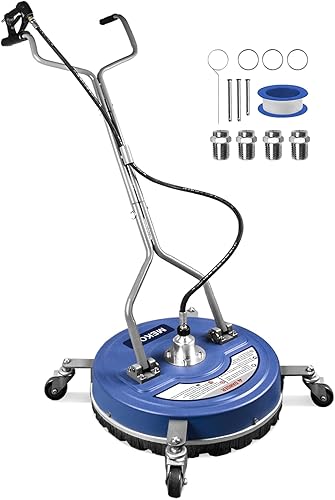
MEKOH 20” Heavy-Duty Pressure Washer Surface Cleaner: Best for wide driveway passes
- 20-inch cleaning area
- Two handles
- Four universal wheels
- Up to 4500 PSI
The 20-inch head is suited to broad paved areas when your pressure washer meets its minimum pressure and flow requirements.
Pros
- Wide 20-inch path
- Dual handles
- Four casters
Cons
- Requires a pressure washer
- Best results call for 3400 PSI or higher
The MEKOH 20” Heavy-Duty Pressure Washer Surface Cleaner is built for wide driveway passes. Its 20-inch cleaning area, two handles and four universal wheels help you move across a broad paved surface with both hands on the attachment.
MEKOH specifies compatibility with pressure washers rated at least 2000 PSI and 2 GPM. It says 3400 PSI or higher gives better results, so this is a better match for a stronger washer than for a small low-flow unit.
The attachment has two spinning jets, changeable nozzles and a stated maximum of 4500 PSI and 4 GPM. Its lightweight PP material, solid brass parts and sealed bearing are designed for use with cold, hot or soapy water.
The two handles help you steer without twisting through one arm. The wheels keep the head level, which supports a consistent cleaning path.
Choose it when reducing the number of passes matters most. Move more slowly if the driveway has stubborn dirt, because pushing too fast can leave areas under-cleaned.
Slow, overlapping passes also help on stained concrete. Slowing down gives the jets more time to loosen soil before you rinse the area clean.
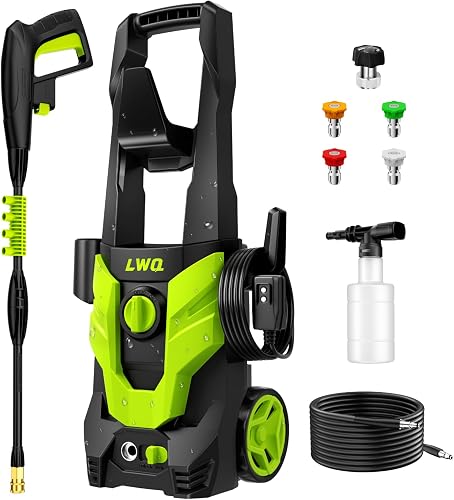
LWQ Pressure Washer: Best for portable driveway cleanup
- 2030 PSI maximum pressure
- 2.5 GPM maximum flow
- Four metal spray nozzles
- Foam cannon
This compact LWQ washer uses two rollers, an anti-tipping base and four spray patterns for moving between driveway, patio and vehicle jobs.
Pros
- Two rollers
- Four quick-connect nozzles
- Foam cannon
Cons
- 2030 PSI maximum pressure
- Requires air removal from hoses before use
The LWQ Pressure Washer is a portable option for driveway, patio and vehicle work. It reaches 2030 PSI maximum pressure and 2.5 GPM maximum flow, with four metal quick-connect nozzles covering 0°, 15°, 25° and 40° patterns.
Two rollers make it easier to move, while the anti-tipping base helps keep the body stable when parked. The hose measures 6.3 meters, giving you reach around outdoor cleaning areas without moving the machine as often.
A foam cannon and detergent bottle add a soap step for loosening grime. The washer also supports faucet or bucket water collection, according to the product information.
The four patterns let you match the spray to the task. A wider pattern suits a first rinse, while a narrower pattern suits a stubborn mark.
Before starting, exhaust air from the high-pressure hose and inlet hose. That setup step helps the machine spray properly.
Choose this model if portability and a higher stated flow rate matter more than a built-in surface cleaner. It suits homeowners who move between several small outdoor jobs.
Hourleey 14" Pressure Washer Surface Cleaner: Best for wheeled control
- 14-inch cleaning width
- Stainless steel construction
- Four wheels
- Up to 4000 PSI
Four wheels and a 14-inch stainless steel head make this a practical coverage upgrade for compatible driveway washers.
Pros
- Stainless steel body
- Four wheels
- Two extension wands
Cons
- Requires a compatible washer
- Suggested washer pressure is 2500 PSI or above
The Hourleey 14" Pressure Washer Surface Cleaner suits driveway owners who want a wheeled 14-inch attachment. Its stainless steel body, heavy-duty bearing and four wheels are designed for cleaning flat areas such as driveways, patios, decks and sidewalks.
Hourleey gives it a maximum pressure of 4000 PSI and recommends using a pressure washer at 2500 PSI or above for better cleaning. The 1/4-inch quick plug connects with compatible pressure washer wands.
The package includes two extension wands, a nozzle cleaner, thread seal tape, 4 O-rings and two replacement nozzles. Four wheels allow the head to move across the surface without carrying the full attachment.
The wheels also help keep the spray distance steady. That can make each pass more uniform than a freehand wand pass.
Choose it for a smaller driveway or for sections where a 20-inch head would feel too wide. Confirm your washer connection and pressure before ordering.
Check the quick plug on your washer before you buy. A matching connection makes setup simple, while a mismatch may need an adapter.
WOJET 20'' Commercial Pressure Washer Surface Cleaner: Best for high-flow machines
- 20-inch cleaning area
- Dual handles
- Four wheels
- Up to 4500 PSI and 4 GPM
This wide stainless steel surface cleaner suits compatible washers above 2000 PSI and 2 GPM, with dual handles for driveway control.
Pros
- 20-inch path
- Dual handles
- Sealed and pre-greased swivel
Cons
- Needs a compatible washer
- 27 lb weight
The WOJET 20'' Commercial Pressure Washer Surface Cleaner is the high-flow choice among the wide attachments here. It has a 20-inch stainless steel body, dual handles, four wheels and a maximum rating of 4500 PSI and 4 GPM.
WOJET specifies use with compatible gas or electric pressure washers above 2000 PSI and 2 GPM. The 3/8-inch quick-plug inlet is designed for quick connection, but your washer and hose must use a matching setup.
A fully sealed and pre-greased swivel helps limit debris entering the swivel during cleaning. The package includes two replacement nozzles, a nozzle cleaner, a manual, Teflon tape and assembly rings and pins.
The dual handles give you two handed control on a wide head. That control matters when you turn at the end of a long driveway pass.
This model weighs 27 lb, so it is a substantial attachment even though the wheels help with movement. Pick it when your washer has enough flow and you want a wide path for large driveway areas.
Store the attachment dry and check the nozzles after use. Clearing debris helps the spinning jets keep working evenly on the next job.
Westinghouse WPX3000e Electric Pressure Washer: Best for higher electric pressure
- 3000 max PSI
- 1.76 max GPM
- 25 ft hose
- Five nozzle set
The WPX3000e combines a 3000 PSI maximum rating with a 25-foot hose, five nozzles and a 0.45-gallon soap tank.
Pros
- 3000 max PSI
- 25 ft hose
- 10-inch never-flat wheels
Cons
- 36.8 lb weight
- Corded AC power source
The Westinghouse WPX3000e Electric Pressure Washer has the highest maximum pressure among the standalone washers in this roundup. It reaches 3000 max PSI and 1.76 max GPM, with rated performance of 2600 PSI and 1.1 GPM.
A 25-foot abrasion-resistant hose and 35-foot GFCI power cord give it extended reach. The 5-nozzle set includes 0°, 15°, 25°, soap and turbo options, so you can switch between focused cleaning, wider coverage and soap application.
The 0.45-gallon onboard soap tank keeps detergent available without a separate bottle. Ten-inch never-flat wheels help move the 36.8-pound frame around the driveway.
The longer hose helps when the water source sits far from the far end. You can work across more of the driveway before you need to move the unit.
Choose this model when you want more stated pressure from an electric machine and have room for a larger washer. It also supports compatible accessories with M22 fittings, including surface cleaners and foam cannons.
Plan the cord route before you start. Keeping the cord clear of the spray path helps you move without stepping over it.
Westinghouse ePX3100s Electric Pressure Washer: Best for compact storage
- 2100 max PSI
- 1.76 max GPM
- 20 ft hose
- Foam cannon and turbo nozzle
The 13.5-pound ePX3100s is easy to carry and store while still offering a 20-foot hose and driveway-ready spray options.
Pros
- Compact design
- 13.5 lb weight
- 35 ft GFCI power cord
Cons
- Lower maximum pressure than the WPX3000e
- No surface cleaner included
The Westinghouse ePX3100s Electric Pressure Washer is the easiest standalone machine here to carry and store. It weighs 13.5 lb, measures 13 in long by 9.7 in deep by 8 in high, and reaches 2100 max PSI and 1.76 max GPM.
Its 20-foot high-pressure hose and 35-foot GFCI power cord help you work around vehicles and outdoor spaces. Built-in holders keep the spray gun, lance and standard spray nozzles together between jobs.
The included foam cannon adds a soap option, while the turbo nozzle is suited to tougher concrete and driveway stains. The 15° and 25° nozzles provide narrower patterns for brick and paved outdoor surfaces.
The compact size suits a closet, garage corner or storage shelf. You can carry it out for a quick job and put it away without much hassle.
Choose this pressure washer for occasional driveway cleaning when compact storage matters. It does not include a surface cleaner, so wide driveways will take more wand passes.
Keep the wand moving and start with a wide pattern. That habit helps you judge the surface before you use a narrower tip.
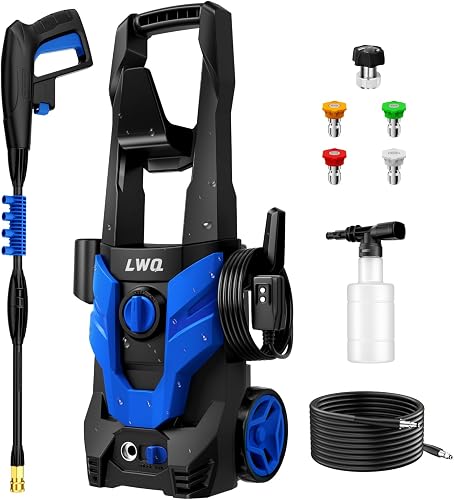
LWQ Pressure Washer: Best for basic electric cleaning
- 2030 PSI maximum pressure
- 2.5 GPM maximum flow
- Four quick-connect nozzles
- Foam cannon
This dark blue LWQ model provides four spray patterns, a foam cannon, two rollers and compact storage for routine driveway cleaning.
Pros
- Four metal nozzles
- Foam cannon
- Two rollers
Cons
- 2030 PSI maximum pressure
- No surface cleaner included
The LWQ Pressure Washer is a basic electric choice with the same stated 2030 PSI maximum pressure and 2.5 GPM maximum flow as the light green LWQ model. It includes four metal quick-connect nozzles and a foam cannon.
The two rollers and anti-tipping base help with movement and stability. A power-cord hook and nozzle holders make storage simpler in a garage or pantry.
This model can be used for concrete, pavement, driveways, patios, decks, sidewalks, vehicles, boats, homes and fencing. Before switching it on, remove air from the high-pressure and inlet hoses.
The foam cannon gives you a soap step before rinsing. That step can help loosen grime on a car, fence or patio before the spray pass.
Choose it when you want a compact electric machine with several spray patterns and a foam cannon. For a large driveway, plan on slower wand passes or add a compatible surface cleaner.
The rollers make short moves simple between jobs. Roll it to the tap, set the base down, and start cleaning.
How we picked the best driveway pressure washers
The best driveway pressure washers need enough pressure and flow for the job without making setup harder than necessary. We compared the stated pressure, water flow, hose reach, spray options, mobility and coverage accessories.
Why cleaning power matters for a driveway
Cleaning power combines pressure and water flow, not PSI alone. Our guide to what cleaning power means on a pressure washer explains why two machines with similar PSI can handle a surface differently.
A narrow spray can target a stain, but it covers less area per pass. A wider tip covers more ground, while a surface cleaner uses spinning jets inside a fixed housing to make repeated passes more consistent.
Flow also affects rinse speed. A machine with more flow can carry loosened dirt away faster on a wide driveway.
How much coverage do you need?
A 14-inch surface cleaner is easier to position around edges and smaller paved areas. The Biswing and Hourleey models fit this group, but both require a compatible pressure washer.
A 20-inch attachment can reduce the number of passes across a broad driveway. The MEKOH and WOJET models need enough washer flow, so compare their minimum requirements with your machine before connecting them.
Which spray tips help with driveway cleaning?
Start with the widest pattern that can remove the dirt, then move to a narrower pattern only when needed. Keep the spray moving and begin farther from the surface so you can judge the result before bringing the nozzle closer.
Never aim a narrow high-pressure stream at people, pets, windows or delicate finishes. Keep connections locked and inspect the hose, wand and nozzle before use.
Do you need detergent?
Detergent can help loosen grime before rinsing, but use only a cleaning solution suitable for your washer and surface. Our guide to what soap you can use in a pressure washer covers the basic choice.
Apply soap according to the machine's setup, allow suitable dwell time without letting it dry, then rinse from a clean section toward the drainage area. Follow local rules for runoff where applicable.
How much hose reach is enough?
A longer hose can reduce how often you move the washer. The Westinghouse WPX3000e has a 25-foot hose, the Sun Joe and ePX3100s have 20-foot hoses, and the LWQ models use a 6.3-meter hose.
If your washer's supplied hose is too short for the driveway layout, compare the connection type before adding one of the best pressure washer hoses. Keep the hose away from sharp edges and vehicle tires.
Can a wall-mounted washer work for a driveway?
A wall-mounted pressure washer can save floor space when the installation point is close to the outdoor cleaning area. See the best wall mounted pressure washer if storage is your main concern.
For a portable driveway setup, a wheeled washer is usually simpler because you can move it to the water source and power outlet. Check the cord path before starting and keep electrical connections away from standing water.
How to use a pressure washer for a driveway
The safest approach is to clear the driveway, connect the water and power, test a wide spray, then work in overlapping sections. Start at the highest point and direct dirty water toward the planned drainage area.
Remove loose leaves, stones and other debris before spraying. Check the hose and quick-connect fittings, then run water through the system as directed by the machine instructions.
Dress for the job before you turn the washer on. Waterproof footwear, eye protection and gloves help protect you from splash and cold water.
Use a wide nozzle for the first pass. Keep the wand moving at a steady pace and avoid holding one spray point over concrete, brick, wood or painted surfaces.
Test the spray on a small hidden area first. That test shows how the surface reacts before you clean the full driveway.
For a surface cleaner, confirm the attachment meets the washer's pressure and flow requirements. Push it in slow, overlapping lines rather than stopping in one place.
Keep your hands on the handles and your feet clear of the path. The wheels guide the head, but you still control speed and direction.
If you use detergent, apply it as the machine instructions direct. Let it sit only as directed, and never let it dry on the surface.
Rinse from the clean area toward the dirty area. That order helps dirty water flow away instead of settling back on cleaned pavement.
After cleaning, rinse detergent from the machine and attachment. Clear nozzle openings as needed, disconnect the water supply and store hoses and accessories where they won't kink or collect dirt.
Drain water from the hose before storage. A straight, dry hose is easier to use next time and less likely to collect grit.
Check the hose and fittings after each use. Look for cracks, loose connections and worn nozzles, then replace parts as directed.
Keep children and pets away while you work. Store the machine and accessories where they cannot be reached between jobs.
Which is the best driveway pressure washer for you?
Choose the Sun Joe Pressure Washer if you want the most spray and detergent flexibility from a standalone electric machine. Pick the Westinghouse WPX3000e if higher stated pressure and a longer hose matter more.
For a large paved driveway, choose the MEKOH or WOJET 20-inch surface cleaner only when your washer meets the required flow. For smaller areas, the Biswing and Hourleey 14-inch attachments are easier coverage upgrades.
If storage and carrying weight are the main concerns, the Westinghouse ePX3100s is the compact pick. For related outdoor hard-surface work, compare the best pressure washers for patios before choosing your final setup.
Think about how often you will use the machine. A compact washer suits occasional spot cleaning, while a wide surface cleaner suits a large driveway you clean each season.
Think about the shape of the area too. A narrow driveway with tight turns may suit a 14-inch head, while a wide open slab suits a 20-inch head.
Check the power source for your home. Electric models need a safe outlet and a clear cord path, while a surface cleaner needs a compatible washer.
Check the water source as well. A longer hose helps when the tap sits far away, but it also needs a clear path across the driveway.
Match the spray options to your jobs. A foam cannon helps with cars and soap jobs, while a turbo nozzle helps with tough marks on concrete.
Match the weight to your storage space. A heavier machine may be fine in a garage, while a lighter machine suits a small closet.
Do not buy a surface cleaner before you check the minimums. The washer must meet the pressure and flow needs, or the head will not clean as intended.
A complete machine is the simpler first purchase. Add a surface cleaner later if the driveway takes too long with a wand.
That staged approach spreads the cost. You can test the washer first, then decide if wider coverage is worth the upgrade.
Our top 3 picks at a glance
-
1
-
2
Best for compatible gas washers
Biswing 14" Pressure Washer Surface Cleaner
9.7/10 our score
See it on Amazon -
3
Best for wide driveway passes
MEKOH 20” Heavy-Duty Pressure Washer Surface Cleaner
9.7/10 our score
See it on Amazon
Frequently asked questions
What is the best pressure washer for driveways?
The best pressure washer for driveways depends on the driveway size and the accessory you plan to use. Sun Joe gives flexible electric spray control, while the Westinghouse WPX3000e has the highest maximum pressure among the standalone washers here.
For broad paved areas, add a compatible 14-inch or 20-inch surface cleaner.
What PSI should a pressure washer for driveways have?
A pressure washer for driveways should match the soil, surface and accessory requirements. The machines here range from 2030 to 3000 PSI maximum pressure.
Surface cleaners have their own limits, such as 2000 PSI minimum for the Biswing and MEKOH models, so check both pressure and water flow before connecting them.
Is a surface cleaner better than a spray nozzle for a driveway?
A surface cleaner can cover a wider path and help create more even passes than a single spray nozzle. The 14-inch Biswing and Hourleey models suit smaller areas, while the 20-inch MEKOH and WOJET models cover more per pass when the pressure washer meets their flow requirements.
What nozzle should I use on a driveway?
Use the spray tip that matches the surface and cleaning task, starting with a wider pattern and keeping the wand moving. The Sun Joe includes 0°, 15°, 25°, 40° and soap tips.
The LWQ models include 0°, 15°, 25° and 40° metal nozzles plus a foam cannon.
Can I use a pressure washer surface cleaner with an electric washer?
Yes, when the electric washer meets the surface cleaner's connection, pressure and flow requirements. The WOJET and MEKOH models specify compatibility with many electric and gas washers above 2000 PSI and 2 GPM, while the Biswing requires at least 2000 PSI and 1.8 GPM.


