How to Get Thicker Foam from a Foam Cannon
To make a foam cannon more foamy, use the right soap dilution, enough water flow, the correct pressure, and a clean orifice. Adjust the cannon gradually instead of adding soap without checking the setup.
On this page (9 sections)
- How to Get Thicker Foam from a Foam Cannon
- How do you make a foam cannon more foamy?
- Is the soap dilution causing thin foam?
- Can low water flow make foam thin?
- Which foam cannon settings make thicker foam?
- Does the orifice size affect foam?
- What should you check if the foam cannon still sprays thin?
- How should you clean and store a foam cannon?
- Which foam cannon fix should you try first?
How to Get Thicker Foam from a Foam Cannon
To make a foam cannon more foamy, start with the correct soap dilution, confirm enough water flow, adjust the foam control, and clean the orifice. If those checks don't help, the cannon may have the wrong orifice for your pressure washer.
Thick foam needs the right balance of soap, water, air, and pressure. Adding more soap is only one possible fix, and it won't solve a clogged inlet or a pressure washer that cannot supply enough flow.
How do you make a foam cannon more foamy?
Use the soap maker's dilution guidance, mix it with suitable water, and adjust the cannon toward a thicker setting. Test the spray after each change so you can tell which adjustment helped.
Follow this order:
- Empty and rinse the bottle if old soap or debris is inside.
- Mix car wash soap and water at the recommended ratio.
- Attach the cannon securely to the pressure washer gun or wand.
- Confirm the pressure washer supplies enough water for the cannon.
- Turn the foam control toward a thicker mixture.
- Adjust the spray angle for a useful pattern.
- Inspect the suction inlet and orifice if the foam stays thin.
A narrow spray pattern can make the foam look more concentrated, while a wider pattern covers more area. The spray angle changes how the mixture lands, but it cannot replace the correct soap ratio or water flow.
For soap choices and dilution basics, see our guide to car wash soap. If you are new to the equipment, how to make a foam cannon explains the main parts and setup.
Is the soap dilution causing thin foam?
Yes, the mixture is one of the first things to check. Too much water can make the spray runny, while too much soap can waste concentrate and still leave the cannon struggling with flow or suction.
Use a clean bottle and measure the mixture consistently. Warm water can help dissolve soap during setup, but avoid guessing if the soap manufacturer gives a specific ratio.
A translucent bottle makes it easier to see how much mixture remains. The McKillans Foam Cannon has a wide-mouth, 1-liter bottle, which gives you more room to mix the solution and see the cleaner level.
McKillans describes this model as working with electric and gas-powered pressure washers. Its title also identifies an adjustable thick-foam function and a 1/4 quick connector.
Check that your pressure washer connection and operating limits match before use.
The wide base can help when you are filling and mixing the bottle. If your main problem is spilling or tipping during setup, that design may be more useful than simply choosing a larger container.
Can low water flow make foam thin?
Low water flow can prevent a pressure-washer foam cannon from drawing and mixing soap correctly. Check the pressure washer's water supply, hose, inlet screen, and operating requirements before changing the soap ratio.
Open the water supply fully and avoid a kinked garden hose. A dirty inlet screen can restrict flow, while a pressure washer with insufficient output may not match the cannon's needs.
Pressure and flow are different. A machine may show a high pressure figure but still need enough water volume for the cannon to create a steady mixture.
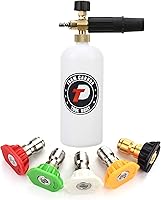
The Tool Daily Foam Cannon requires a pressure washer and a standard 1/4-inch quick-connect gun or wand. It has a 1-liter container, a stated working range of 1,000 to 3,000 PSI, and a 1/4-inch quick-connect inlet.
Tool Daily includes 5 nozzle tips with 0, 15, 25, 40, and 65 degree angles. The top knob adjusts foam dispensing, while the nozzle adjusts the spray pattern.
This option suits someone who wants several spray angles for car washing and other cleaning tasks. It does not attach directly to a garden hose, water hose, or faucet, so it is the wrong type if you do not have a compatible pressure washer gun or wand.
Which foam cannon settings make thicker foam?
Turn the top control toward the thickest mixture, then reduce the spray angle only as much as needed for your wash area. Make small changes because the best setting depends on the soap, water flow, pressure, and orifice.
A control knob changes how much soap enters the water stream. If the knob is set for a lighter mixture, the cannon may produce wet, loose foam even when the bottle contains the right soap ratio.
The spray adjustment affects the pattern and coverage. A narrow pattern may place more foam in one area, while a wider pattern can spread the mixture over a larger section.
Keep the cannon moving while applying foam. A thicker mixture is meant to cling and loosen dirt before contact washing, but it still needs a safe wash process with a clean mitt and plenty of rinsing.
Our guide to how to wash a car with a foam cannon covers where foaming fits into the full wash sequence. For the basic purpose of this tool, see do foam cannons work.
Does the orifice size affect foam?
Yes, the orifice can affect how a foam cannon mixes soap and water. If the orifice is blocked or does not suit the pressure washer, the foam may stay thin, spray unevenly, or fail to draw soap.
Inspect the orifice and suction inlet when the usual adjustments do not help. Use a fine needle to clear a small blockage gently, without enlarging the opening.
Some cannons allow an orifice change. The Tool Daily instructions describe removing the 1/4-inch quick-connect plug, unscrewing the orifice with a slot screwdriver, and installing a replacement orifice.
Do not choose an orifice based only on pressure. Match the part to the cannon and pressure washer setup, and follow the cannon's instructions for removal and installation.
What should you check if the foam cannon still sprays thin?
Check for a blocked suction inlet, a blocked orifice, a loose connection, an empty bottle tube, or an incompatible pressure washer. These problems can look like a soap-ratio issue even after the mixture is correct.
Rinse the bottle and pickup tube after use. Soap residue can dry inside small passages and restrict the mixture.
Check every quick connection for a secure fit. A poor connection can cause leaks or an unstable spray, while a damaged seal can affect how the cannon operates.
Keep the bottle upright during use. A wide-mouth bottle can make filling easier, but the pickup tube still needs access to the mixture.
If you need a hose-only option, the SwiftJet Car Wash Foam Gun + Microfiber Wash Mitt is designed to attach to a standard garden hose. It does not require a pressure washer or extra tools, and it has 6 adjustable foam settings.
SwiftJet suits beginners who want a simple hose attachment for car cleaning. Its title identifies an orange foam gun, a microfiber wash mitt, and compatibility with any soap.
This is a different tool category from the pressure-washer cannons above. Choose it when a garden hose is your available water source, and choose a pressure-washer cannon when you have a compatible 1/4-inch quick-connect setup.
How should you clean and store a foam cannon?
Rinse the cannon with clean water after every wash, then store it with the bottle and passages free of leftover soap. Cleaning helps prevent dried residue from restricting the suction inlet or orifice.
Empty unused mixture instead of leaving it in the bottle for the next wash. Rinse the container, pickup tube, nozzle area, and connector according to the product instructions.
If foam output drops during a wash, stop and check the inlet and orifice before repeatedly turning the control knob. A blockage will not be fixed by adding more soap.
Keep small replacement parts together if your cannon supports orifice or foam-maker changes. Do not force threaded parts or use a sharp tool aggressively, because changing the opening can affect the spray.
Which foam cannon fix should you try first?
Start with dilution, water flow, and the top adjustment knob, then inspect the orifice and suction inlet. This order addresses the most common causes without changing parts unnecessarily.
Choose the McKillans model if a wide-mouth, 1-liter bottle and adjustable foam output fit your setup. Choose the Tool Daily model if you need a 1/4-inch quick connection plus 5 spray-angle tips.
Choose the SwiftJet foam gun if you want garden-hose use without a pressure washer. For a broader comparison, see our guide to the best foam cannon for the money.
The best answer to how to make a foam cannon more foamy is to match the cannon to the water source, use the correct dilution, adjust the mixture gradually, and keep the small passages clear.
Frequently asked questions
How do I make my foam cannon produce thicker foam?
Use the soap and water ratio recommended for your car wash soap, then adjust the cannon's top control knob toward a thicker mixture. Confirm that the pressure washer has enough water flow, use the correct orifice, and clear any blockage from the inlet or nozzle.
Does more soap make a foam cannon foam better?
Not always. Too much soap can waste concentrate without fixing weak foam caused by low water flow, a blocked orifice, the wrong orifice size, or an incorrect adjustment.
Start with the correct dilution, then change one setting at a time.
Why is my foam cannon spraying watery foam?
Watery foam usually points to a dilution, flow, pressure, setting, or blockage problem. Check the soap mixture, confirm the pressure washer meets the cannon's requirements, turn the adjustment knob toward a thicker mix, and inspect the nozzle and suction inlet.
Can a garden hose make thick foam?
A garden-hose foam gun can create suds without a pressure washer, but it uses a different design from a pressure-washer foam cannon. Choose a hose foam gun when you lack a pressure washer, and choose a pressure-washer cannon when your setup supports its pressure and quick connector.