Do Foam Cannons Work?
Yes, foam cannons work by covering surfaces with soapy foam that helps loosen and lubricate dirt. They make washing safer and easier, but most vehicles still need a careful contact wash for complete cleaning.
On this page (7 sections)
Yes, foam cannons work by spreading soapy foam over a surface so it can loosen dirt, add lubrication, and reduce the amount of grit you drag across paint. They make washing safer without changing your whole routine.
They work best as a pre-wash step, not as a promise of completely touch-free cleaning. Think of the foam as preparation rather than the full wash itself.
Foam does not magically dissolve every mark. It separates loose contamination from the surface so rinsing can carry some of it away.
That matters because loose grit is the part you most want to avoid moving across paint. Removing it first means your wash mitt starts with less to drag around.
Foam also adds slip for a short time. That extra lubrication can make the next stage feel smoother, especially on large panels.
Dwell time helps, but only while the surface stays wet. A thin drying layer will not do the same work as foam that stays active.
Use a proper car wash soap for this job. Dish soap and laundry products can be too harsh for paint and trim.
Heat and sunlight also change the result. Work in shade on a cool panel so the soap has more time to work before it dries.
A foam cannon suits people who wash at home and want a repeatable process. It suits cars, trucks, wheels, and other exterior surfaces where a pre-wash can lift loose dirt.
It also suits owners who already have a compatible pressure washer or a garden hose setup. The right choice depends on your water source and connector, not on foam thickness alone.
Used this way, washing feels calmer and more controlled. The foam loosens dirt, adds lubrication, and buys time before contact.
How does a foam cannon work?
A foam cannon works by combining water, car wash soap, and air to create a layer of suds. A pressure washer supplies the water flow, while the cannon's controls adjust the mixture and the spread of the foam.
The adjustment knob changes how much cleaning solution enters the water stream. The nozzle or spray control changes the pattern, so you can cover a broad panel instead of directing all the foam into one narrow stream.
Start with a suitable car wash soap and follow its dilution instructions. Soap that is too concentrated can waste product, while a mixture that is too weak may produce thin foam.
A foam cannon is not the same as a regular spray nozzle. The cannon is designed to aerate the solution, which creates cling and gives the soap more time to contact the surface.
Do foam cannons really clean dirt from a car?
Yes, foam cannons help clean by softening and lubricating loose dirt before contact. The foam can help suspend grime so rinsing removes part of it before a mitt touches the paint.
Their biggest benefit is process control. A pre-rinse removes loose grit, foam loosens more contamination, and a final contact wash deals with the film that remains.
Foam thickness alone does not prove cleaning power. Thick foam may look impressive, but the result also depends on soap choice, water flow, dwell time, surface temperature, and how dirty the vehicle is.
Use the foam as a short dwell step. Don't let the soap dry on the paint, glass, trim, or wheels, especially in direct sun.
Can foam remove every kind of dirt without contact?
No, foam usually cannot remove every kind of dirt without contact. Bonded road film, oily residue, dried insects, and stubborn grime may remain after the foam is rinsed away.
A touch-free pre-wash can still be valuable because it removes some loose material first. That means your wash mitt has less loose grit to move across the paint.
Rinse from the top of the vehicle downward. Use enough water to carry loosened dirt away, then inspect the surface before deciding whether a contact wash is needed.
For the full process, follow this guide on how to wash a car with a foam cannon. It helps place foaming, rinsing, and contact washing in the right order.
Which foam tool suits your setup?
Choose a pressure washer foam cannon when you already have a compatible pressure washer gun or wand. If you wash with a standard garden hose, choose a hose-based foam gun instead.
The McKillans Foam Cannon for Pressure Washer is a pressure washer option with a wide-mouth bottle, adjustable foam output, adjustable spray angle, a 1/4 quick connector, and a 1-liter tank. Its listed maximum flow rate is 2.5 GPM and its listed maximum pressure is 3,000 PSI.
Its wide bottle can make dilution easier and provides a stable base while you fill it. The translucent bottle lets you see remaining cleaner, while the brass connectors and stainless steel quick connector are intended for pressure washer use.
This cannon suits readers comparing options for an electric or gas-powered pressure washer. Check your gun or wand connection and operating needs before ordering.
For more options, see the best foam cannon for an electric pressure washer.
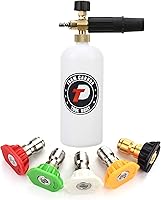
The Tool Daily Foam Cannon with 1/4 Inch has a 1-liter container, a 1/4-inch quick connector, and 5 nozzle tips with 0, 15, 25, 40, and 65 degree angles. It is designed for use with a pressure washer gun or wand, not directly with a garden hose, water hose, or faucet.
Its working pressure range is 1,000 to 3,000 PSI. The top knob adjusts foam output, while the nozzle adjusts the spray pattern.
This is the better fit if you want several included angle tips for tasks such as car washing, siding, floors, windows, driveways, or roofs. It is not the right choice if you need a hose-only attachment.
The SwiftJet Car Wash Foam Gun + Microfiber Wash Mitt is a garden hose foam sprayer that does not require a pressure washer. It has 6 adjustable foam settings and is described for cars, trucks, wheels, glass, and trim.
This option suits households that want a simpler hose setup. Its trade-off is that it uses standard garden hose water rather than a pressure washer system, so the spray and foam experience differ from a pressure washer cannon.
How should you use a foam cannon?
Use a foam cannon in this order: rinse, foam, dwell, rinse, then contact-wash if needed. This sequence gives loose grit a chance to leave the surface before a mitt moves across it.
- Rinse the vehicle from top to bottom to remove loose dust and grit.
- Fill the cannon with the recommended amount of car wash soap and water.
- Adjust the foam output and spray pattern before covering the vehicle.
- Apply foam from the roof downward.
- Let it dwell briefly while keeping it wet.
- Rinse thoroughly, then inspect the surface.
- Use a clean wash mitt if road film or bonded dirt remains.
For filling steps, see how to fill a foam cannon. Always check the tool's connector before attaching it to a pressure washer wand.
Why is my foam cannon not making thick foam?
Thin foam can result from incorrect dilution, low water flow, a clogged orifice, or an unsuitable connection. Thick foam also depends on the soap and the tool's adjustment settings.
Start by checking the mixture. Then inspect the inlet and orifice for blockage, following the tool's care instructions.
On the Tool Daily model, the nozzle and internal foam parts can be removed for cleaning or replacement.
Adjust the top control and spray pattern gradually. More foam is not always better if it dries quickly or makes rinsing harder.
If you want to change the texture, read how to make a foam cannon more foamy. If the tool still performs poorly, compare the best 1.1mm orifice for a foam cannon, but confirm compatibility first.
Are foam cannons worth the extra setup?
Foam cannons are worth using when you want a repeatable pre-wash step that reduces loose grit before contact cleaning. They are less useful if you only need a quick rinse or do not have a compatible pressure washer connection.
The McKillans option favors a wide-mouth 1-liter bottle and adjustable coverage. Tool Daily favors a 1-liter bottle with 5 angle tips and a defined 1/4-inch quick-connect setup.
SwiftJet favors hose convenience, 6 foam settings, and no pressure washer requirement.
For a broader comparison, see the best foam cannons for the money. Choose based on your water source, connector, cleaning routine, and need for spray-pattern control.
So, do foam cannons work?
Yes, foam cannons work best as a pre-wash tool that loosens dirt and adds lubrication before contact washing. They can improve the process, but foam thickness does not guarantee that every mark will rinse away.
That is the honest trade-off. Foam can lift loose dust and light grime, yet bonded film, dried bugs, and oily residue often still need a mitt to shift.
Pick McKillans if you want a wide-mouth pressure washer cannon with adjustable foam output and spray angle. The wide bottle is easier to fill and steady to set down, and it holds 1 liter.
Pick Tool Daily if its 1/4-inch connection and 5 nozzle tips fit your setup. The extra tips give you more choice for narrow or wide coverage in a 1-liter bottle.
Pick SwiftJet if you want a garden hose foam gun without a pressure washer. It suits a simple hose setup with 6 foam settings, though the spray differs from a pressure washer cannon.
Match the tool to the water you already use. Check the connector before you order, and keep the soap dilution right for the product you choose.
The safest routine is simple: rinse first, foam second, rinse again, and contact-wash only where the surface still needs it. Keep foam wet, work in shade where you can, and rinse from the top down.
That order gives loose grit a chance to leave before your mitt touches the paint. It also keeps the wash gentle and easy to repeat.
Frequently asked questions
Do foam cannons really work on dirty cars?
Yes, foam cannons help loosen and lubricate dirt before you touch the paint. They work best as a pre-wash step, because thick foam can carry loosened grime downward.
A contact wash is still needed when bonded dirt, road film, or other residue remains after rinsing.
Does a foam cannon clean a car without touching it?
Usually, no. A foam cannon can remove loose dust and some surface grime without contact, but it does not replace a careful wash for every vehicle.
Rinse first, apply suitable car wash soap, let the foam work briefly, rinse it away, and contact-wash any remaining film.
How does a foam cannon work?
A pressure washer foam cannon mixes water, soap, and air as the solution passes through its internal parts. The adjustment controls change the soap mixture and spray pattern.
A garden hose foam gun uses lower-pressure hose water and its own adjustment system to spread suds over the vehicle.
Are foam cannons worth using with an electric pressure washer?
They can be useful when the cannon matches the pressure washer gun or wand and produces enough water flow for the tool. Check the connector, pressure range, and orifice needs before buying.
A garden hose foam gun is another option when you don't own a pressure washer.