How to Make a Foam Cannon
To make a foam cannon, assemble a chemical bottle, soap pickup tube, foam maker, adjustable nozzle, and pressure washer connector. Match the connector and orifice to your equipment, then test the mix at low output.
On this page (8 sections)
- What parts do you need to make a foam cannon?
- How do you assemble a homemade foam cannon?
- How should you choose the bottle and connector?
- How do you mix soap for a homemade foam cannon?
- How do the orifice and nozzle affect foam?
- How should you use the foam cannon on a car?
- What should you clean after making a foam cannon?
- Is making a foam cannon worth it?
To make a foam cannon, assemble a soap bottle, pickup tube, foam maker, adjustable control, spray nozzle, and matching pressure washer connector. The parts must seal tightly, draw diluted soap, and mix it with pressurized water before the foam reaches the car.
A homemade setup can be simple, but the connector and orifice need careful attention. A bottle that leaks or a fitting that does not match your pressure washer can make the project unsafe and frustrating.
What parts do you need to make a foam cannon?
A working foam cannon needs five core sections: the bottle, soap pickup path, foam-making insert, nozzle, and pressure connection. Each part has a separate job in the water and soap mixture.
The bottle holds the diluted car wash soap. A pickup tube reaches into the liquid and feeds it toward the mixing area.
The foam maker adds turbulence and air to the soap mixture. The control knob changes how much soap enters the water stream, while the nozzle changes the spray pattern.
The inlet connector attaches the cannon to a pressure washer gun or wand. A common setup uses a 1/4 in quick connector, but you must match the connector to your existing equipment.
Use a dedicated car wash soap rather than household dish soap. The soap should mix easily with water and be suitable for automotive surfaces.
How do you assemble a homemade foam cannon?
Start with the bottle, then install the pickup tube, foam insert, nozzle, and connector in the correct flow order. Keep the threads straight and check that every seal sits flat before adding water.
- Rinse the bottle and confirm that its opening and threads are clean.
- Fit the pickup tube so it reaches the soap inside the bottle.
- Install the foam-making insert in the mixing body.
- Attach the spray nozzle and control knob.
- Fit the connector that matches your pressure washer gun or wand.
- Add diluted soap and water, leaving room for the mixture to move.
- Tighten the bottle and inspect the joints for gaps.
- Test the cannon with the spray pointed away from people, pets, and delicate surfaces.
Do not force a fitting that feels cross-threaded. A damaged thread can cause leaks, and replacing a connector is easier than trying to seal a damaged joint with excessive tape.
Can you use a foam cannon with a garden hose?
A pressure-washer foam cannon needs a pressure washer, while a garden-hose foam gun uses hose pressure and a different body design. Do not attach a pressure-washer cannon directly to a garden hose, water hose, or faucet unless its instructions specifically allow that connection.
The SwiftJet Car Wash Foam Gun + Microfiber is the hose-based option here. It has 6 adjustable foam settings, works with any soap according to its product title, and includes a microfiber wash mitt.
Choose this style if your main goal is a simple hose attachment. Choose a pressure-washer foam cannon if you already have the matching gun or wand and want that equipment to power the spray.
How should you choose the bottle and connector?
Choose a bottle that is stable, easy to fill, and large enough for the wash you plan to do. Then confirm that the connector, thread, and pressure range suit the pressure washer.
The McKillans Foam Cannon for Pressure Washer uses a 1-liter translucent bottle, a wide-mouth design, an adjustable foam control, and an adjustable spray angle. Its title also identifies a 1/4 quick connector.
The wide mouth makes dilution easier, while the translucent bottle lets you see the remaining cleaner. Its product data gives a maximum pressure of 3000 psi and a maximum flow rate of 2.5 gpm.
McKillans describes the connectors as brass and the bottle as strong plastic. Those materials can suit readers who want a stable bottle and visible soap level, but connector compatibility still comes first.
For replacement parts, see the guide to best foam cannon replacement bottles. If you want to connect two accessories, compare the best foam cannon dual connector accessory options.
How do you mix soap for a homemade foam cannon?
Begin with the soap maker's dilution guidance, then adjust the water and control knob in small steps. A mixture that is too thick may not draw well, while too much water can produce thin foam.
Use warm water only when the soap instructions allow it. Pour water carefully to reduce splashing, then add soap and close the bottle before shaking or turning it upside down.
Set the control toward less soap for the first test. Increase the soap feed gradually until the spray covers the target surface with a useful layer.
Foam thickness also depends on water flow, the nozzle, the orifice, the soap, and the surface temperature. Read how to make foam cannon more foamy for adjustment ideas that do not require guessing.
Which pressure-washer foam cannon is easiest to set up?
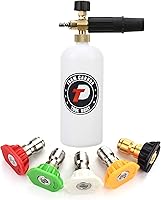
The Tool Daily Foam Cannon with 1/4 Inch is suited to readers who want a 1/4 in quick-connect setup with five nozzle tips. Its title specifies a 1-liter capacity, and the product data gives a working range of 1000 to 3000 psi.
The five included tips have 0, 15, 25, 40, and 65 degree angles. The adjustable top knob changes foam output, and the nozzle changes the spray pattern.
Tool Daily states that this cannon must connect to a standard 1/4 in quick-connect pressure washer gun or wand. It is not for direct connection to a garden hose, water hose, or faucet.
The product data identifies a plastic exterior finish and a 150 g item weight. Choose it when the included nozzle choices matter more than a wide-mouth bottle.
How do the orifice and nozzle affect foam?
The orifice controls how the cannon draws and mixes the soap, while the nozzle controls the direction and spray pattern. A blocked orifice can stop soap pickup even when the bottle and connector are installed correctly.
Use a fine needle only to clear a small blockage if the component instructions allow it. Do not enlarge the opening with a drill or sharp tool, because changing the opening can alter the water and soap balance.
If you need a replacement part, compare the best 1.1mm orifice for foam cannon options and check the fit before ordering. The right part depends on the cannon design and pressure washer flow.
A nozzle that spreads the spray widely can cover a vehicle faster. A narrower pattern can place foam in a more focused area, but you should keep the spray moving and follow safe washing distances.
How should you use the foam cannon on a car?
Rinse loose grit first, apply foam from the bottom upward, let it dwell without drying, then rinse from the top down. Foam helps suspend dirt, but it does not remove every contaminant without careful rinsing and contact washing.
Work in the shade when possible. Avoid letting soap dry on hot paint, glass, trim, or wheels.
Do not treat thick foam as proof that the mixture is cleaning better. The goal is a lubricated layer that gives dirt time to loosen before you rinse and wash.
Follow the full process in how to wash car with foam cannon. To understand what foam can and cannot do, read do foam cannons work.
What should you clean after making a foam cannon?
Rinse the bottle, pickup tube, foam insert, and nozzle after every use. Soap residue can dry inside narrow passages and reduce the cannon's ability to draw liquid.
Empty the remaining mixture instead of storing it in the bottle. Flush the system with clean water, then allow the parts to drain before storage.
Inspect the bottle threads, connector, seals, and tube for cracks or looseness. Replace worn parts before the next wash, and never operate a leaking cannon near electrical equipment.
Is making a foam cannon worth it?
Making a foam cannon is worthwhile when you enjoy assembling compatible parts and can match the connector, orifice, and pressure range. Buying a complete cannon is simpler when you want predictable assembly and included adjustment parts.
Choose McKillans for a wide-mouth 1-liter bottle, adjustable foam and spray angle, and a translucent container. Choose Tool Daily for a 1-liter 1/4 in quick-connect cannon with 5 nozzle tips.
Choose SwiftJet for a garden-hose setup with 6 foam settings and a microfiber mitt.
If you prefer a ready-made option, compare the best foam cannon for the money. For a homemade build, start with the connector and flow requirements, then choose the bottle and foam parts around them.
Frequently asked questions
What parts do you need to make a foam cannon?
You need a chemical bottle, pickup tube, foam-making insert, adjustable soap control, spray nozzle, and a connector that matches your pressure washer gun or wand. The bottle must seal correctly, and the orifice must suit the washer's flow so the cannon can draw and mix soap.
Can you make a foam cannon without a pressure washer?
You can make a hose-based foam gun, but a pressure-washer foam cannon needs a pressure washer to create its spray and draw soap. A garden-hose foam gun is a different setup.
The SwiftJet Car Wash Foam Gun + Microfiber works with a garden hose and does not require a pressure washer.
Why is my homemade foam cannon not drawing soap?
A blocked pickup tube, clogged orifice, loose seal, wrong connector, or soap mix that is too thick can stop the draw. Clean the inlet, check every threaded joint, dilute the soap with water, and confirm that the pressure washer gun supplies the required connection.
What size orifice should a foam cannon use?
The right orifice depends on the pressure washer's flow and the cannon's design. Do not choose by pressure alone.
If a compatible replacement is needed, compare the best 1.1mm orifice for foam cannon guide and match the part to your equipment.